Inside the work
Process
The making of Trapped, a mixed-media work in which image, material, and tension accumulate layer by layer.
01 — Accumulation
Building in layers
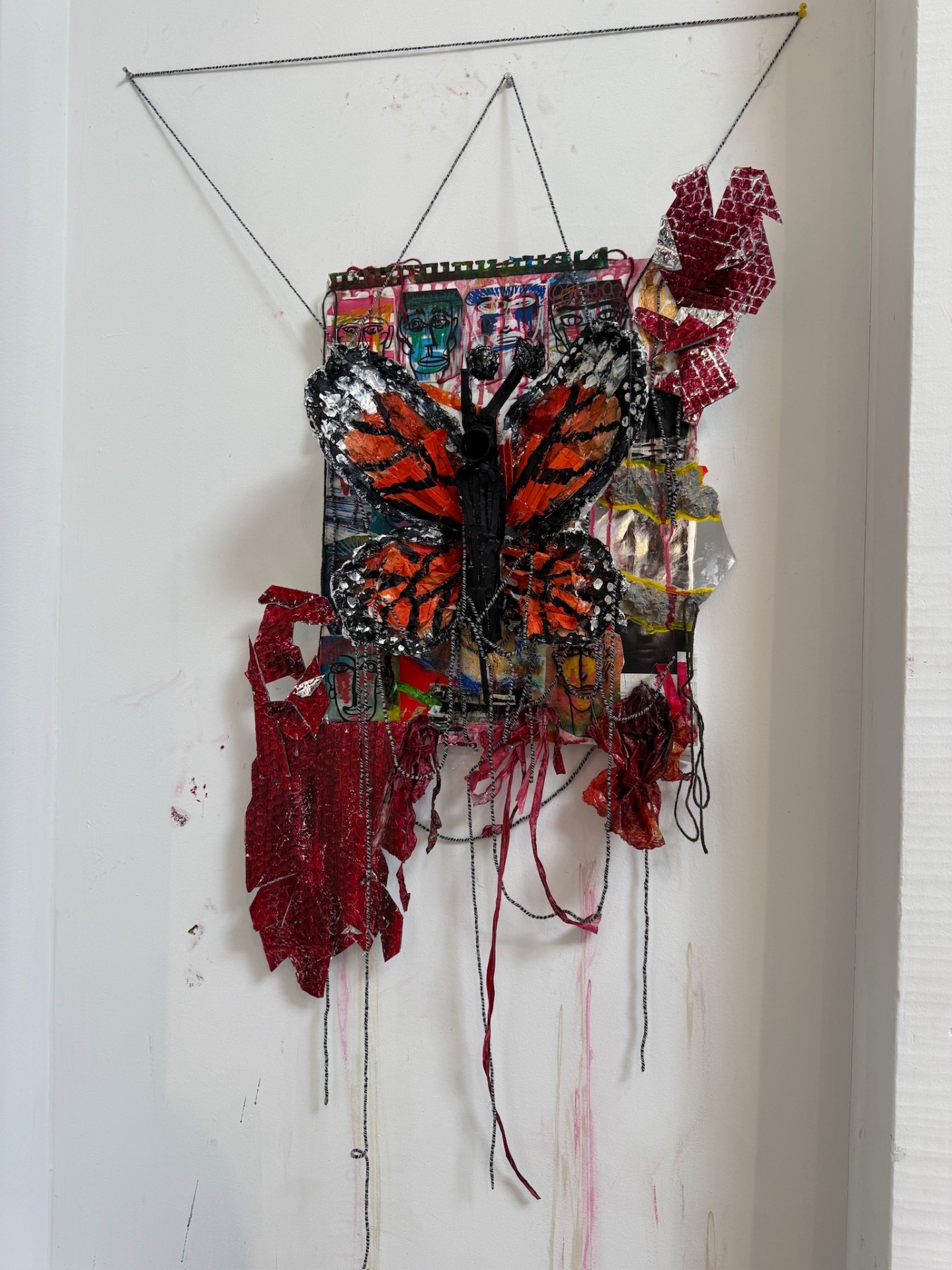
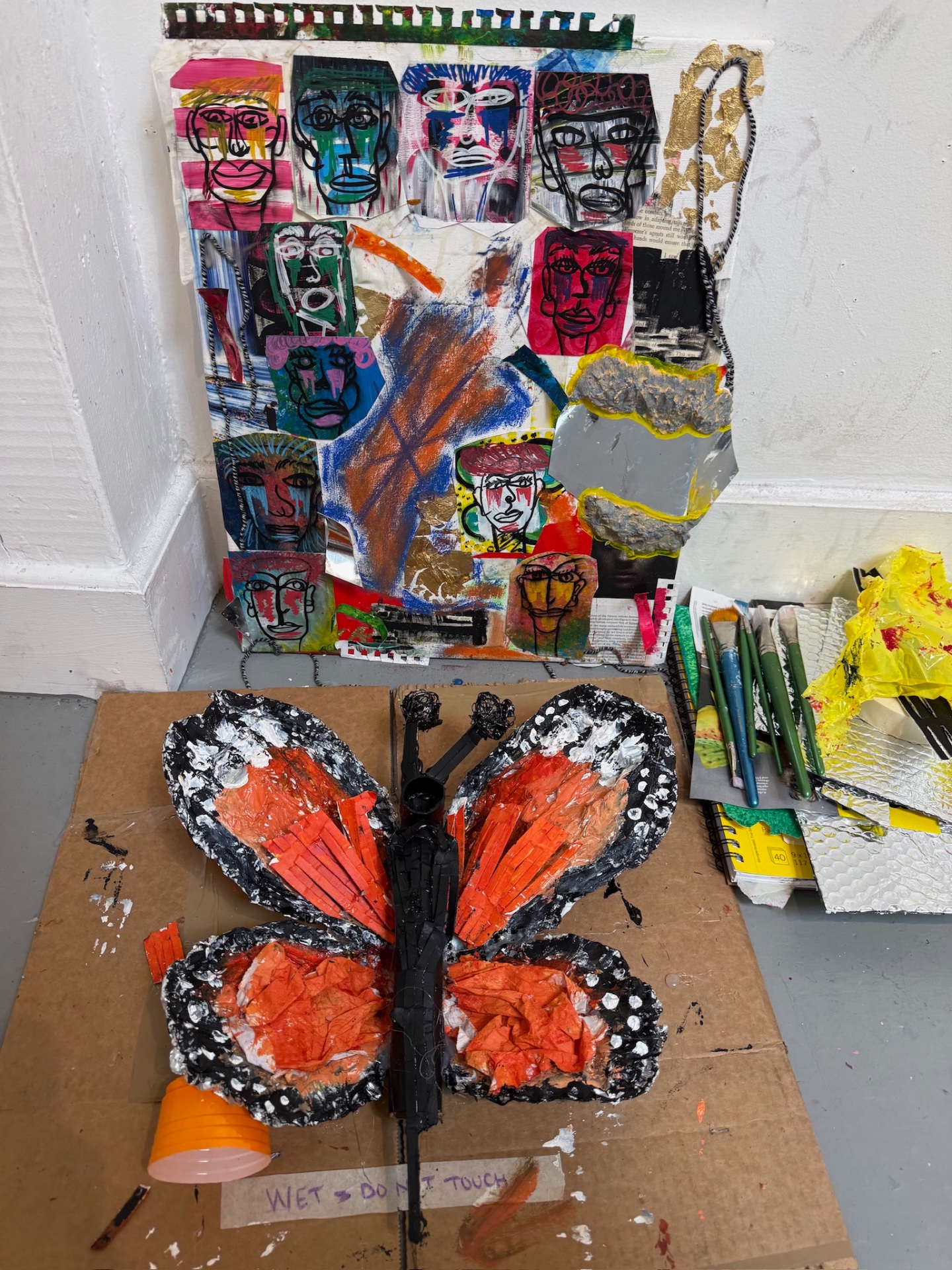
Franny builds mixed-media pieces such as Trapped by allowing one material to answer another. Painted and drawn fragments are joined by foil, paper, ribbon, thread, and sculptural forms. Some layers establish the image; others interrupt it. The surface keeps a record of those decisions rather than hiding how the work was made.
Here, the butterfly and the face-covered ground appear to have been developed as separate elements before being brought together. The distinction matters: the butterfly does not simply sit inside a picture. It occupies the same physical space as the cords, torn edges, and projecting materials around it.
Franny's studies of abstract faces return in portions of the work as bystanders. Their wide, direct gazes suggest people who are always observing what is happening, yet doing little about it. Repeated across different scraps and treatments, they form a quiet audience around the central event.
02 — Connection
Lines of tension
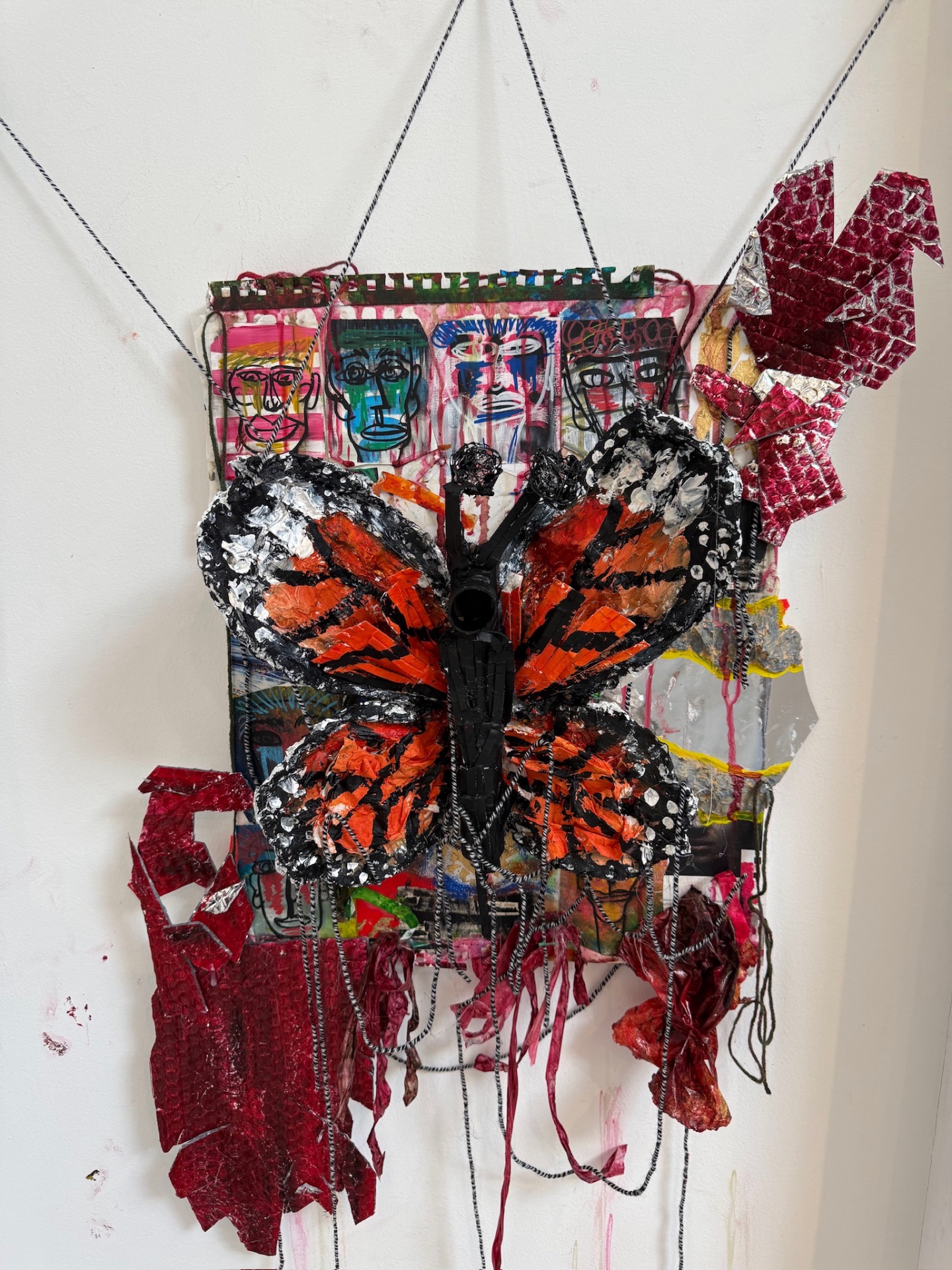
String and yarn often act as connectors in Franny's work. They help describe what is happening in the space without resolving it. A strand may drip loosely, pull taut in a straight line like the bar of a cage, or gather into texture where the surface needs greater weight.
In Trapped, the cords both suspend and confine. They make the work possible as an object while reinforcing its psychological pressure. The butterfly is held up, but it is not free.
The red tones denote suffering. Their crumpled, torn, and trailing forms resist becoming a single symbol; they can read at once as wound, warning, or residue. Against the orange and black wings, the red gives the composition its most urgent pulse.
03 — Reflection
The viewer enters the work
The smallest additions can alter the whole encounter. Pieces of mirrored paper catch a blurred version of the viewer's face, placing another witness among the abstract faces already in the work. The reflection never becomes a clear portrait. Instead, it asks the viewer to recognize their presence inside the scene and to consider whether looking is itself enough.
This device sharpens the role of the painted bystanders. They observe without intervening; the viewer sees themselves doing the same. What first appears to be a richly decorated surface thus develops an ethical edge, turning spectatorship into part of the subject.
04 — Composition
The first feeling, then the second
Franny makes careful choices of color and composition so the viewer receives an immediate feeling from the piece. That first response may remain, or it may evolve as the eye moves across quieter details and discovers how the layers relate.
From a critical vantage point, the butterfly creates a productive contradiction. Its symmetry promises order, but the surrounding field refuses it: faces are cropped, surfaces change abruptly, and cords escape the panel. Beauty becomes a lure into a more unsettled space.
The rough joins are essential. Torn edges, uneven dots, twisted wire, and pooled strands preserve the energy of making. They keep Trapped from becoming a sealed image; it remains active, provisional, and emotionally unresolved.